May 16, 2008
By Rebecca Gladden
Last August, I had the opportunity to interview Kyle Busch when he was in Phoenix for a fan event.
At the time, Busch was still driving the No. 5 car at Hendrick Motor Sports, but his move to Joe Gibbs Racing for the 2008 season had already been announced.
Kyle was polite and patient throughout the afternoon, interacting with fans, answering questions, signing hundreds of autographs, posing for pictures, and working his way through a throng of media members lined up for one-on-one interviews - including me.
One of the things I asked Kyle that day was about his relationship with the fans, and whether he felt his reputation would improve once he moved to Gibbs.
Kyle told me, "I think the fans have had their reaction of who I am already, I guess, and hopefully we can try to change that a little bit with showing exactly who I am. I've done a pretty good job of showing them the wrong person, so I don't blame them. But maybe we can turn that around some."
It sounded to me, at least, that Kyle was not relishing the bad-boy role as much as people might have thought - that he was aware he'd made some mistakes and was optimistic for a fresh start with a new race team.
How he planned to improve his image by joining ranks with the pugnacious Tony Stewart and pouty Denny Hamlin remained to be seen. Perhaps he was banking on the overall popularity of the Gibbs' drivers compared to the Hendrick's boys, especially Jeff Gordon, whom fans have held in disdain for decades.
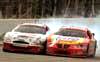
But whatever hopes Busch had to "turn around" his reputation evaporated two weeks ago in Richmond when he turned around Dale Earnhardt Jr. on the track - stealing a likely victory from the grasp of NASCAR's most popular driver and casting Busch once again in the familiar role of the villian.
In retrospect, most experts and fair-minded fans labeled the incident a racin' deal. Earnhardt Jr. commented that he'd done similar things himself. "I have done that before," he said after the race, "that's what happens if he got loose underneath me."
But the Junior Nation was in no mood for apologies. It had been over two years since Earnhardt last visited Victory Lane in a points-paying race, and he came so close at Richmond that the fans could taste it - until, they contend, Busch put him in the fence, ending not only Junior's quest for victory, but Busch's for a fresh start with the fans.
It wasn't just the collision itself that angered fans, but his comments afterwards, which many perceived as haughty and combative. Of course, the fact that he saw tens of thousands of fans giving him the middle finger and trashing his car with beer cans after the incident had little to do with whatever surliness fans perceived in post-race interview.
In the weeks that followed, the media has been quick to capitalize on the controversy, labeling Busch "Public Enemy Number One" and practically salivating at the thought of an ongoing Earnhardt-Busch rivalry. Rumors swirled that Busch needed extra security at Darlington the following week and broadcasters hyped the prospect of an outraged reaction when his name would be called at driver introductions.
So it's no surprise that when Kyle appeared on ESPN's "NASCAR Now" this week, the issue of his relationship with the fans was broached. Busch was asked about the fan reception at Darlington and how he managed to cope with the hatred.
"As long as I'm out there doing what I do best, which is to try to compete and win races, everything else doesn't matter," he said. "I just don't care. Those guys can say what they want and do what they want. To me, it just doesn't matter. I'm here to do a job, and whether I'm getting cheered for doing my job because I'm good at it, or being booed because I'm good at it - yet people don't like me for whatever reason - it just doesn't matter."
Okay. That was three "it doesn't matters" and one "I just don't care" over the course of about 30 seconds. During the rest of that segment of the interview, he added a fourth "it just doesn't matter."
So I get the intended message - Kyle wants us all to know that fan hostility doesn't bother him in the least.
But there's one big problem with that assertion - the big unspoken "but" that followed his initial answer. It was what he said next that belied his cavalier denials and revealed his true feelings:
"Ever since I came into the sport of NASCAR just after my 18th birthday - before I even had my first race - I was getting booed … You try to go out there and you try to be the nice guy and do what you can, and support the well-beings of others and stuff like that, but you just don't get credit for it, and you just get criticized for any little bad thing that you do. Whatever it is that happens to you happens to you, so you just keep going."
I'm sure many of you Busch-haters are thinking, "Boo-hoo, Kyle. Cry me a river."
But when you stop to think about it, Kyle has had an uphill struggle from the beginning - coming into the sport as the brother of then most-hated driver Kurt Busch, and becoming teammates with long-time NASCAR whipping boy Jeff Gordon.
I contend that all that cockiness isn't Busch's true personality as much as it is a coping defense developed out of necessity.
Busch has done a lot away from the track that fans seldom hear about. Among other things, at the ripe old age of 21, he formed his own charitable foundation - something which many older and more popular drivers have yet to do.
Notably, his foundation isn't tied to a high-profile cause. Busch quietly chose to help a largely underserved population - children living in residential foster homes around the country.
According to the Foundation's website (www.KyleBuschFoundation.org) , Kyle made the decision to nurture this cause after a visit to the St. John's Home in Michigan, where "he realized the things most people take for granted are the very things that these children need - a safe home where they are encouraged to learn and are taught the skills to achieve their dreams."
Many in the media claim that Kyle Busch is not only accepting, but relishing his role as NASCAR's most hated driver. When he was booed at Darlington, he smirked and wiped away a fake tear. When fans hurled beer cans at him, he joked that next time the cans should be full so he can at least enjoy the beverage inside. And just to rub a little salt in the wound, he went out and methodically led the most laps at Darlington, won the race, and expanded his lead in the Sprint Cup standings by 61 points, and took a congratulatory bow on the roof of his race car in front of the largely outraged crowd.
But really, what choice does he have?
Let me be clear here. I'm not a Kyle Busch fan, per se. But I try to be objective and to treat people fairly. In writing about NASCAR, I call 'em as I see 'em.
If you think that Kyle Busch longs to be NASCAR's bad boy, I think you're wrong. And his own words support my contention.
Nobody "wants" to be hated by millions of people, especially by the very fans of the sport where Busch will most likely be making his living for the next few decades.
I think for the most part Busch has been judged unfairly since he entered the sport. That brashly arrogant "I don't care" mentality is not only a defense mechanism, it's a survival mechanism.
You probably don't agree. Time will tell which of us is right.
You can contact Rebecca at.. Insider Racing News
 You Can Read Other Articles By Rebecca
The thoughts and ideas expressed by this writer or any other writer on Insider Racing News, are not necessarily the views of the staff and/or management of IRN.